As digital transformation accelerates, organizations face a critical challenge: deploying software faster without compromising security or stability. Traditional CI/CD pipelines—often manual, script-heavy, and prone to configuration drift—can’t keep pace with the growing demands of Kubernetes, multi-cloud environments, and AI-driven development.
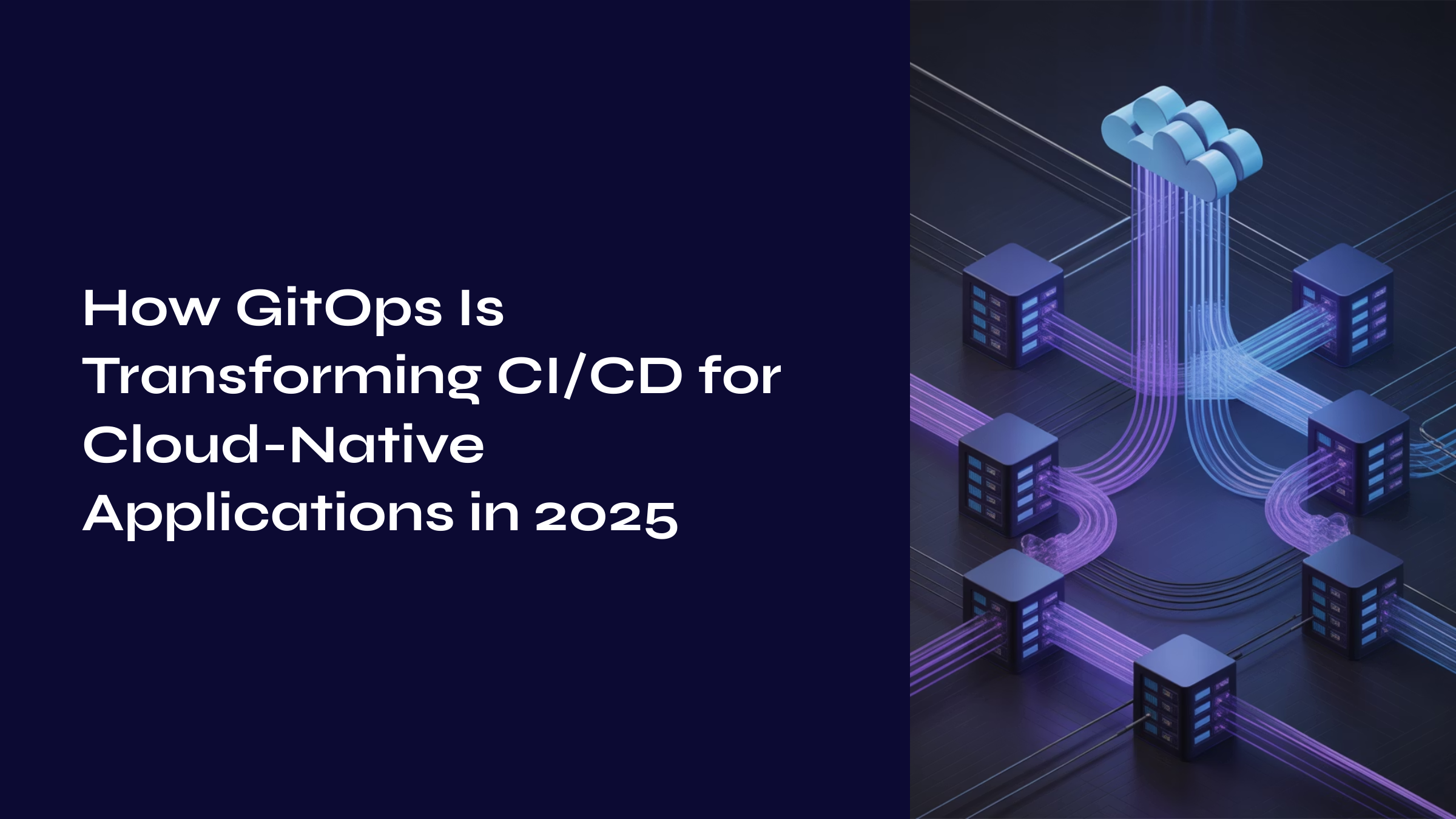
That’s where GitOps comes in—emerging as the transformative approach redefining deployment strategies in 2025. By using Git as the single source of truth for infrastructure and applications, GitOps enables automated, secure, and self-healing deployments. It enforces policies, reduces human error, and optimizes pipelines with intelligent automation.
In this article, we’ll explore how GitOps is reshaping CI/CD pipelines, the latest trends for 2025, and how your organization can benefit from it.
What Is GitOps?
GitOps is a modern deployment methodology that uses Git repositories as the central source of truth for both infrastructure and application configurations. By leveraging tools like Argo CD and Flux CD, GitOps ensures that your live environment stays in sync with configurations stored in Git, providing a host of advantages:
- Self-healing systems that automatically correct configuration drift
- Auditable changes via Git’s version history, ensuring full traceability
- Policy-enforced deployments that reduce human error and ensure compliance
- One-click rollbacks using Git revert to minimize deployment failure risks
As we move further into 2025, GitOps has expanded its capabilities beyond Kubernetes to manage serverless, edge, and multi-cloud environments—all through Git’s familiar workflow. It’s now the gold standard for teams that want to automate their infrastructure management securely and reproducibly.
GitOps vs. Traditional DevOps: Key Differences
Aspect | Traditional DevOps | GitOps |
Change Management | Manual scripts or CLI commands | Declarative configurations stored in Git |
Error Resistance | Prone to human errors and configuration drift | Self-healing automation with version control |
Auditability | Limited visibility into changes | Complete audit trail through Git commit history |
Rollback Speed | Complex and time-consuming recovery | Instant rollbacks with a single Git commit |
Security | Manual policy enforcement | Policy-as-Code integrated into Git workflows |
Collaboration | Siloed deployment processes | Unified Git-based workflow for dev and ops teams |
This principle eliminates manual deployment steps while giving teams complete visibility and control over the entire system state, enhancing both operational efficiency and security.
Why GitOps Matters for Cloud-Native CI/CD
In cloud-native ecosystems—driven by Kubernetes, microservices, and distributed architectures—traditional deployment methods are hitting their limits. Manual scripts and complex pipelines can no longer keep up with the speed, scale, and complexity of modern applications.
GitOps addresses this by transforming Git into your deployment command center:
- Slow Deployments: With GitOps, push-to-Git triggers instant, automated rollouts, eliminating the need for manual approvals or scripts.
- Security Gaps: All changes are tracked through Git commits, enforcing RBAC, signed commits, and policy checks, ensuring robust security.
- Multi-cluster Chaos: GitOps allows you to synchronize hundreds of clusters and environments from a single Git source, using tools like Flux or Argo CD.
- Audit Nightmares: Every change is tied to a unique Git SHA, making it easy to track changes and simplify compliance for SOC2, HIPAA, and other audits.
- Configuration Drift: Self-healing systems automatically correct any deviations from the desired state declared in Git, ensuring consistency across environments.
Key Trends in 2025 Driving GitOps Adoption
- AI-Powered Deployment Validation
GitOps now leverages predictive AI and ML models to analyze deployment risks before they happen, reducing failures and improving reliability. - Self-Service with Platform Engineering
Internal Developer Platforms (IDPs) powered by GitOps enable true developer autonomy, allowing teams to deploy faster without bottlenecking on DevOps. - Built-In Security with DevSecOps
Security is no longer an afterthought. Automated scanning, policy enforcement, and compliance checks are embedded directly into Git workflows. - Enterprise-Grade Scalability
Managing hundreds of clusters? GitOps ensures consistent, auditable, and automated deployments across global Kubernetes environments at scale. - Hybrid & Edge Cloud Simplicity
From data centers to edge locations, GitOps simplifies multi-cloud and distributed deployments, making infrastructure management seamless.
Why It Matters: GitOps is no longer just a CI/CD enhancement—it’s becoming the standard for modern, secure, and scalable deployments in 2025.
Top GitOps Tools & Platforms in 2025
Tool | Best For | Key Feature |
Flux CD | Kubernetes-centric teams | AI-driven reconciliation for seamless updates and rollback. |
Argo CD | Multi-cluster deployments | Real-time sync dashboard for visualizing deployment status. |
Jenkins X | Cloud-native CI/CD + GitOps | Pipeline-as-Code for simplified and automated workflows. |
Dagger | Portable GitOps workflows | Flexibility to run anywhere—locally or in the cloud. |
Crossplane | GitOps for infrastructure management | Unified control over applications and infrastructure. |
Real-World GitOps Use Cases in 2025: Industry Applications
Key industries are embracing GitOps to drive secure, compliant, and efficient software delivery at scale.
Financial Technology – Automated Compliance Deployments
- Seamless regulatory updates: New banking regulations are deployed automatically through GitOps, minimizing manual effort.
- AI-powered compliance validation: Machine learning analyzes each commit against regulatory policies before merging.
Outcome: Reduces compliance risk while enabling zero-downtime deployments.
Healthcare – Secure and Auditable Delivery Pipelines
- Immutable, encrypted version control: Protects patient data and ensures HIPAA compliance.
- Instant rollback capabilities: Quickly reverses faulty updates without service disruption.
Outcome: Maintains regulatory integrity while accelerating critical updates.
IoT & Edge Computing – Scalable Device Management
- Centralized configuration control: Synchronizes updates across 10,000+ edge devices from a single Git repository.
- Uniform deployment at scale: Maintains consistent versions across distributed environments.
Outcome: Minimizes drift and reduces operational complexity.
AI/ML Operations – Reproducible Model Lifecycle Management
- Version-controlled ML pipelines: Tracks data, models, and deployment configs in Git for full transparency.
- End-to-end traceability: Supports reproducible training and rapid rollback of production models.
Outcome: Brings rigor and reliability to AI workflows with GitOps precision.
Why It Matters: GitOps is no longer just a toolset—it’s a foundational framework enabling secure, scalable, and audit-ready operations across highly regulated and fast-moving industries.
Common GitOps Challenges and Proven Solutions
As GitOps adoption grows, teams face real-world challenges. Here’s how to address the most common ones effectively:
Challenge 1: Secure Secret Management in Git Repositories
Problem: Storing sensitive credentials directly in Git introduces significant security risks.
Solution:
- Use HashiCorp Vault for dynamic, on-demand secret generation
- Implement Sealed Secrets to store encrypted secrets safely in Git
- Leverage External Secrets Operators for Kubernetes-native secret management
Challenge 2: Managing Complex Stateful Applications
Problem: Traditional GitOps workflows are optimized for stateless apps—handling persistent storage and databases adds complexity.
Solution:
- Use Helm charts with lifecycle hooks for controlled provisioning and teardown
- Apply Kustomize for clean, environment-specific overlays
- Integrate Terraform to manage infrastructure dependencies alongside application code
Challenge 3: Scaling GitOps Across Multiple Teams
Problem: Without structure, cross-team deployments can lead to access conflicts and security gaps.
Solution:
- Define strict RBAC policies by environment and role
- Segment repositories by team or application domain
- Adopt GitOps promotion models to separate responsibilities and approvals across stages
Challenge 4: Tool Sprawl and Operational Complexity
Problem: Using too many disconnected tools leads to inefficiencies and maintenance burdens.
Solution:
- Standardize on a core GitOps platform like Argo CD or Flux
- Provide internal templates and golden paths to streamline developer onboarding
- Build a platform engineering team to enforce best practices and tooling governance
Best Practice: Start with opinionated defaults and gradually introduce customization—ensuring governance, security, and consistency remain intact.
How advansappz Accelerates GitOps and Cloud-Native CI/CD Transformation
At advansappz, we empower enterprises to transition from legacy DevOps practices to fully automated, GitOps-driven CI/CD pipelines tailored for cloud-native environments. Our expertise spans the full lifecycle of modern application delivery—bridging infrastructure as code, continuous delivery, security, and observability into a unified, scalable strategy.
Our GitOps & CI/CD Service Portfolio Includes:
- End-to-End GitOps Enablement:
Architect and implement GitOps workflows using enterprise-grade tools like Argo CD, Flux, and native Kubernetes integrations—enabling declarative infrastructure management, automated rollbacks, and consistent deployments across clusters. - Cloud-Agnostic CI/CD Pipeline Modernization:
Design and optimize CI/CD pipelines across AWS, Azure, and Google Cloud Platform to support containerized workloads, serverless functions, and microservices-based applications. - Embedded DevSecOps Practices:
Integrate security at every stage of the pipeline with policy-as-code, RBAC enforcement, secret management, and continuous compliance scanning—ensuring resilience without compromising agility. - Observability & Operational Intelligence:
Deploy advanced monitoring stacks using Prometheus, Grafana, ELK, and OpenTelemetry to deliver real-time insights, proactive alerting, and metrics-driven troubleshooting. - Team Enablement & Governance Frameworks:
Upskill your teams through structured enablement programs, workshops, and documentation. Establish best-practice guardrails to maintain operational integrity while fostering developer autonomy.
Whether you’re initiating your GitOps transformation or scaling it across multi-cloud and hybrid environments, advansappz serves as a strategic partner—delivering proven methodologies and deep technical expertise to drive continuous delivery at scale.
Conclusion
As cloud environments become increasingly dynamic and complex, traditional CI/CD approaches are struggling to keep pace. GitOps provides a modern, secure, and automated framework for managing cloud-native deployments at scale.
2025 is the time to modernize your cloud delivery strategy with GitOps.
Take the Next Step in Your Cloud Transformation
Connect with our cloud experts today to accelerate your GitOps journey and modernize your CI/CD strategy.
Frequently Asked Questions (FAQs) About GitOps and CI/CD in 2025
- What is GitOps and how does it improve CI/CD in 2025?
GitOps is a deployment strategy that uses Git as the single source of truth for infrastructure and app configurations. In 2025, it streamlines CI/CD by automating secure, scalable, and self-healing deployments across cloud-native environments. - How does GitOps differ from traditional DevOps practices?
GitOps replaces imperative scripts with declarative configurations stored in Git. It improves version control, auditability, rollback capability, and compliance—making it more robust than traditional DevOps methods. - Why is GitOps essential for cloud-native and Kubernetes-based applications?
GitOps automates and simplifies the management of Kubernetes and multi-cloud environments. It ensures consistency, reduces configuration drift, and accelerates deployment cycles across distributed systems. - What are the top GitOps tools used in 2025?
Popular GitOps tools include:
- Argo CD: For automated, declarative Kubernetes deployment.
- Flux CD: A lightweight GitOps tool for Kubernetes.
- Jenkins X: Combines CI/CD with GitOps practices.
- Crossplane: A GitOps-based control plane for cloud resources.
- Dagger: A programmable CI/CD pipeline supporting GitOps workflows.
- What are the common challenges in adopting GitOps and how can they be solved?
Key challenges and solutions include:
- Managing secrets: Use Vault or Sealed Secrets for secure storage.
- Handling stateful applications: Apply Helm or Kustomize for lifecycle management.
- Scaling teams: Enforce RBAC and policy-as-code to ensure compliance.
- Tool overload: Standardize on platform-specific GitOps stacks for consistency.