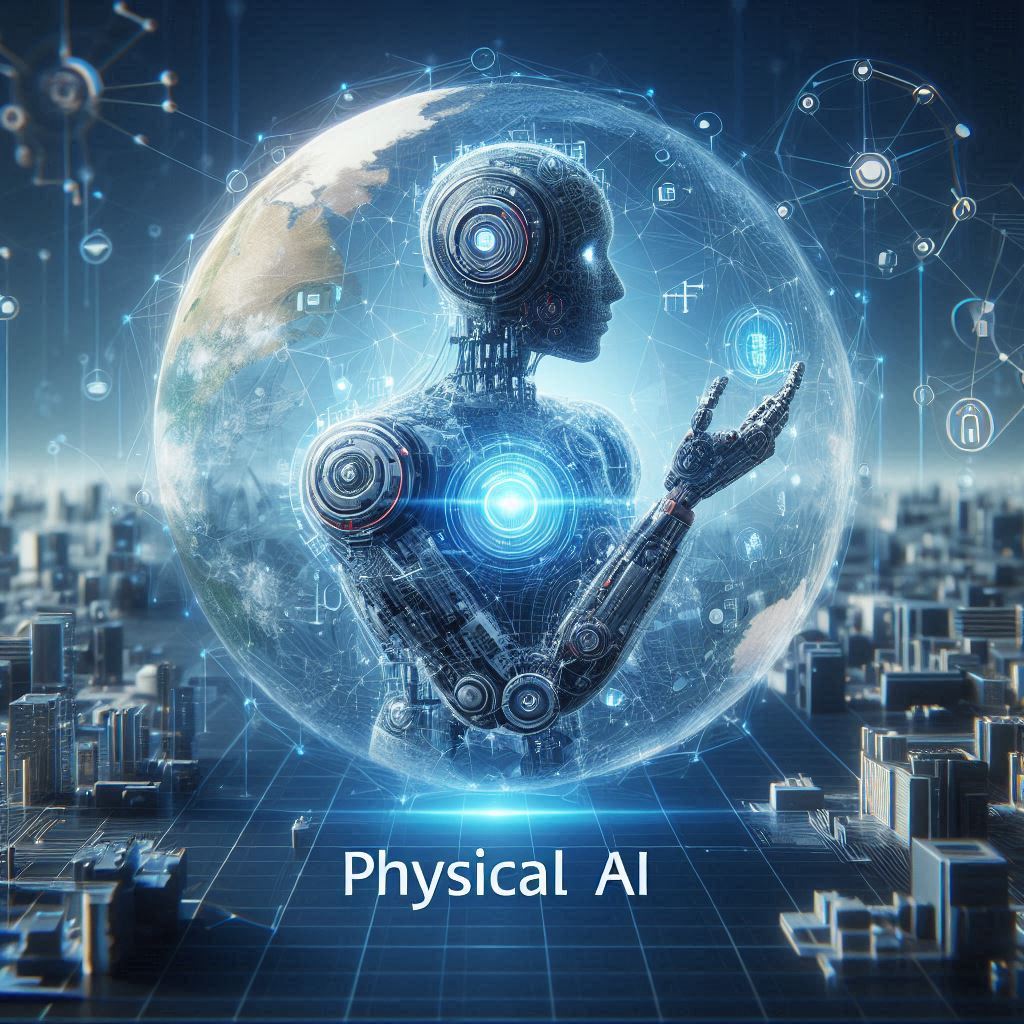
Physical AI refers to the integration of artificial intelligence (AI) with the physical world, allowing machines to interact with, perceive, and manipulate physical objects and environments. This form of AI goes beyond digital or virtual interactions, bridging the gap between the digital and physical realms through sensors, robotics, and real-time decision-making.
Physical AI involves technologies like robots, drones, and autonomous systems that can understand and act within the physical world. These systems use data from sensors (such as cameras, pressure sensors, or motion detectors) and employ AI algorithms to interpret this data and make decisions that guide their physical actions in real time.
Example:
Consider an autonomous delivery robot designed to carry goods from one location to another. Equipped with AI-powered sensors and cameras, the robot can perceive its surroundings, avoid obstacles like pedestrians, navigate sidewalks, and find the most efficient route to its destination. Using AI, it processes real-time data to make decisions, such as determining the safest path around traffic or adjusting its speed based on the environment. This autonomous system effectively transforms digital instructions (like a destination) into physical actions, making it a perfect example of Physical AI in action.
How Does Physical AI Work?
Physical AI involves a series of steps where AI algorithms are combined with sensors and actuators to interact with and understand the physical world. Let’s break it down:
1. Perception:
AI systems rely on sensors like cameras, LiDAR, and motion detectors to gather data from the environment. This enables the system to “see,” “hear,” or “feel” its surroundings, creating a foundation for real-time interaction with the world.
2. Processing:
Once the data is collected, AI algorithms process it to identify patterns, detect objects, and understand the environment. This stage often involves machine learning models that enable the AI system to recognize features in images or sensor data, helping it make informed decisions.
3. Generative Physical AI:
In advanced systems, the integration of 3D training data, known as digital twins, enhances AI’s understanding of the physical world. These models represent real-world environments, helping the AI learn spatial relationships, environmental behaviors (like gravity), and motion dynamics.
4. Decision-Making:
After processing the data, the AI determines the most appropriate action. For example, an autonomous vehicle may decide the safest route to take based on road conditions, or a robotic arm may adjust its movement to avoid obstacles.
5. Action:
AI systems then send commands to actuators such as motors or robotic arms to carry out the desired actions in the physical world. This allows the system to move, manipulate objects, or interact with the environment as needed.
6. Feedback and Adjustment:
In real time, AI systems receive feedback from their actions and adjust accordingly to optimize performance. This ongoing loop of perception, processing, action, and feedback is critical to improving accuracy and efficiency in Physical AI applications.
Key Learning Techniques Driving the Advancement of Physical AI
The effectiveness and adaptability of Physical AI systems are largely driven by the advanced learning techniques they employ. These learning methods enable systems to continuously refine their behaviors and improve their performance in the physical world.
1. Reinforcement Learning (RL):
In Reinforcement Learning, machines learn by interacting with their environment and receiving feedback based on the outcomes of their actions. Over time, this helps systems such as robots, drones, and self-driving cars improve their behaviors, making them more efficient at performing tasks. The continuous feedback loop ensures that the system gradually learns to make better decisions in complex environments.
2. Supervised and Unsupervised Learning:
These learning techniques are foundational in tasks like object detection, facial recognition, and sensor data analysis. In supervised learning, the AI is trained using labeled data, allowing it to learn by example. Unsupervised learning, on the other hand, helps AI systems identify hidden patterns in data, even when labels are absent, which is useful for discovering insights in large datasets.
3. Sim2Real Transfer Learning:
Sim2Real Transfer Learning allows AI models trained in simulated environments (such as digital twins) to be deployed in real-world scenarios. This technique minimizes errors that could occur when transitioning from a controlled digital environment to physical settings, ensuring smoother and more reliable operation in real-world conditions.
4. Imitation Learning:
Imitation Learning enables AI systems to learn tasks by mimicking the actions of humans or other successful agents. This technique is particularly valuable when programming every individual action is too complex. Instead, the AI learns by observing and copying the behaviors of others, allowing it to acquire tasks quickly and efficiently.
Why is Physical AI Important?
The integration of AI with the physical world is revolutionizing industries across the globe. Here’s why Physical AI is so impactful:
Enhanced Automation and Efficiency:
Physical AI automates tasks that were once labor-intensive or required human intervention, boosting efficiency in sectors like manufacturing, logistics, and healthcare. Robots and autonomous systems can now handle repetitive tasks with greater precision and speed.
Improved Decision-Making and Precision:
AI allows machines to make data-driven decisions in real-time, enhancing accuracy and reducing errors. In environments like autonomous vehicles or drones, this leads to more reliable operations and safer decision-making processes.
Better Safety and Risk Reduction:
In hazardous environments, such as manufacturing plants or construction sites, Physical AI can perform dangerous tasks, reducing the risk of harm to human workers. Robotic systems handle toxic materials, high-risk machinery, and other hazardous tasks, contributing to safer workplaces.
Personalization and Customization:
Physical AI enables personalized experiences in industries like retail and healthcare. By analyzing data, AI systems can recommend tailored solutions, such as customized products or treatment plans, based on individual preferences or needs.
Boosting Sustainability:
In agriculture, manufacturing, and energy sectors, Physical AI helps optimize resource usage, minimize waste, and enhance operational efficiency. AI systems can identify energy-saving opportunities, improve supply chain management, and reduce environmental footprints.
How advansappz Can Help with Physical AI Integration
If you’re considering adopting Physical AI solutions, advansappz can assist in integrating these advanced systems into your operations. We specialize in providing tailored AI services, from robotics to autonomous systems, ensuring your business can fully leverage the power of AI to enhance efficiency, precision, and safety in physical environments.
Contact us today to explore how Physical AI can transform your business operations.
Frequently Asked Questions (FAQs)
- What is Physical AI and how does it work?
Physical AI refers to the integration of AI with physical systems, allowing machines to perceive and interact with their environment. It involves data collection through sensors, real-time processing of this data, decision-making, and executing actions in the physical world through actuators, enhancing automation and precision.
- What industries can benefit from Physical AI?
Physical AI is transforming industries such as manufacturing, logistics, healthcare, agriculture, and automotive by enabling automation, increasing efficiency, and enhancing safety across these environments.
- How does Physical AI improve safety in workplaces?
By automating hazardous tasks and employing robots to handle dangerous materials or environments, Physical AI reduces risks to human workers, contributing to safer operational environments, particularly in high-risk industries like manufacturing and construction.
- What role do sensors play in Physical AI?
Sensors are crucial for gathering real-time environmental data that helps AI systems understand and interact with the physical world. This data enables AI to make informed decisions, driving actions such as navigation, manipulation, or monitoring of physical environments. - How does advansappz assist with Physical AI integration?
advansappz provides comprehensive services to integrate Physical AI into your business. From designing systems that interact with physical environments to implementing real-time decision-making capabilities, we ensure seamless integration that enhances automation, safety, and operational efficiency for your company.